
Reviewed · PODGORICA TOURS
MONASTERY TOUR – Impressive Montenegrin Monasteries
Monasteries carved into cliffs and caves make this a memorable day. I like the way this private tour pairs the quiet, unusual Dajbabe Monastery with the grand Cathedral of Christ’s Resurrection, then finishes at Ostrog, Montenegro’s famous pilgrimage site. I also like the personal service: guides such as Tamara, Ivan, Lidia, and Moawyah are praised for clear explanations, careful driving, and flexible pacing. The main drawback is time, since four major stops in about seven hours can feel full, and Ostrog may be crowded.
This is a good choice if you want more than a quick drive to Ostrog. You’ll see Ždrebaonik, a women’s monastery with working spaces for nuns, and hear how these religious sites connect to Montenegrin culture. Pickup is available from your preferred location, with departures possible from Podgorica, Kotor, or Budva, though the longer coastal transfers may leave less time at the monasteries.
In This Review
- Key points before you book
- Why this seven-hour monastery route works
- Dajbabe Monastery and its cross-shaped cave
- Podgorica’s Cathedral of Christ’s Resurrection
- Ždrebaonik, a working women’s monastery
- Ostrog Monastery at 900 meters
- The guides make the private format worthwhile
- Is $132.53 a fair price?
- Timing, pickup, and practical planning
- Who should book this monastery tour?
- Should you book it?
- FAQ
- Where does the monastery tour depart from?
- How long does the tour last?
- What is the price?
- Is this a private tour?
- Which places are visited?
- Does the tour include Upper and Lower Ostrog?
- Is lunch included?
- Is transportation included?
- Is the tour offered in English?
- What is the cancellation policy?
Key points before you book
- Dajbabe begins the day in a cave shaped like a cross, a rare meeting of natural rock and religious design.
- Ostrog is the dramatic finale, built into steep cliffs about 900 meters above sea level.
- Ždrebaonik adds a quieter, more human stop, with a library, dormitories, and workshops where nuns make icons and souvenirs.
- The private format lets the guide adjust the day, including breaks and assistance for travelers with mobility concerns.
- Guides are a major part of the experience, with repeated praise for Tamara, Ivan, Lidia, Moawyah, and Darko.
- The $132.53 price includes private transport and fees, but personal expenses, including lunch, are extra.
Why this seven-hour monastery route works
Montenegro has no shortage of spectacular religious sites, but many short excursions focus only on Ostrog. This route gives you a wider view of the country’s Orthodox tradition by combining a cave monastery, a modern cathedral, a restored convent, and a cliffside pilgrimage center.
That variety matters. Dajbabe feels secretive and intimate. Podgorica’s Cathedral of Christ’s Resurrection is bold and highly decorated. Ždrebaonik shows a living monastic community. Ostrog brings scale, drama, and crowds. You are not simply checking off four churches. You are seeing different ways faith has shaped Montenegrin places and daily life.
The tour is private, so only your group participates. That is a useful advantage on a day with several stops. You can ask questions without holding up a busload of people, and the guide can adjust the pace. Tamara is repeatedly praised for adapting the day to individual needs, while Moawyah is singled out as both a friendly guide and a cautious driver.
The advertised duration is about seven hours. That is enough for the listed stops, but not enough for a lazy, unhurried day at every site. If you are leaving from Kotor or Budva, ask how the pickup and drive affect the schedule. The route is most efficient from the Podgorica area.
A few more Podgorica trips worth weighing up
- Skadar Lake National Park Guided Boat Tour with Wooden Boat
★ 5.0 · 91 reviews - Best from our coast (Kotor bay, Budva, Sv Stefan, Skadar lake)
★ 5.0 · 79 reviews - GREAT MONTENEGRO TOUR Cetinje – Njeguši – Kotor – Budva – Bečići – Saint Stefan
★ 5.0 · 69 reviews
Dajbabe Monastery and its cross-shaped cave
The first stop is Dajbabe Monastery, where the setting is the main surprise. The monastery was adapted inside a cave formed in rock like a cross. It is a place made by both people and nature, rather than a conventional church built outward from a plan.
You get about an hour here, which should give you time to appreciate the unusual shape and hear the story behind the site. This is not the sort of place you visit for a grand exterior. The appeal is the sense of discovery, the rock itself, and the way the religious space fits into it.
Dajbabe also sets the tone for the day. It is quieter and more personal than Ostrog, so you begin with a place where the spiritual character is easier to notice. I would pay attention to the guide’s explanation here, since the physical setting alone may not tell you why the monastery matters.
The practical limitation is that cave spaces can feel less accessible than open churches. The tour information says most people can participate, but it does not provide detailed information about steps or interior access. If you have a serious mobility concern, discuss it with the operator before booking.
Podgorica’s Cathedral of Christ’s Resurrection
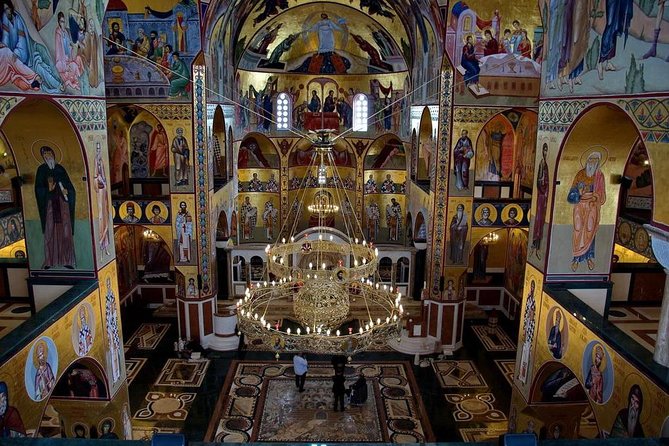
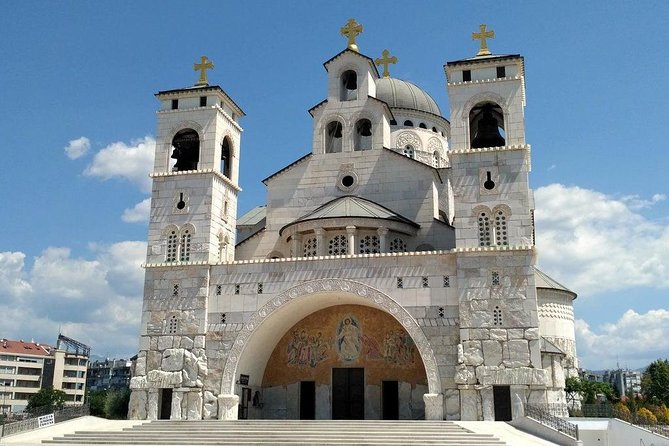
The next stop shifts from an old cave to a modern religious landmark. Saborni Hram Hristovog Vaskrsenja, usually translated as the Cathedral of Christ’s Resurrection, is described as the new sacred symbol of Podgorica.
Its architecture is unusual, and construction took 20 years. The church was completed using techniques that had not been in use for eight centuries, giving the building an interesting link between modern construction and older Orthodox traditions.
You have about 45 minutes here. That is a sensible amount of time for a guided look, especially since the cathedral is one part of a wider day. Your guide can explain the building’s place in modern Podgorica and draw a useful comparison with Dajbabe, the much older and more secluded first stop.
This contrast is one of the best ideas in the itinerary. Instead of treating every monastery as the same, the tour shows you old and new forms of worship in the capital. The cathedral is also likely to appeal to you if you enjoy architecture, decoration, and large-scale religious buildings more than remote pilgrimage sites.
As with any active religious place, dress and behavior should be respectful. The supplied information does not set out a formal dress code, so ask your guide if you are unsure about what to wear.
Ždrebaonik, a working women’s monastery
The drive continues toward Danilovgrad and Ždrebaonik Monastery. This stop offers a different kind of interest because it is a women’s monastery with practical spaces, not only a church to look at.
The site includes a library, dormitories, and areas where nuns make icons and souvenirs. That detail gives the visit a human scale. You can better understand that a monastery is a living community, not just an old monument preserved for sightseeing.
Ždrebaonik has also endured repeated destruction. It was burned and demolished during each war that occurred in the area, yet it was rebuilt and continues to function. I find that history especially valuable because it gives the building emotional weight without requiring grand claims or dramatic storytelling.
Plan on about an hour. This is a useful middle stop, particularly if Ostrog is crowded later in the day. One review specifically praised the smaller monastery in Danilovgrad after finding the crowds at Ostrog tiring. That is good advice: do not rush through Ždrebaonik simply because Ostrog is the headline attraction.
The tour may also include time for lunch or a break around the middle of the day. Lunch is not included in the price, but guides have arranged breaks and meals for past groups. One guide took a group to a restaurant with an excellent view, and another made time to sit by a lake. These pauses are not guaranteed as fixed itinerary stops, but the private format gives you room to ask.
A completely different sort of day out of Podgorica:
- Skadar Lake National Park: Guided Boat Tour to Kom Monastery
★ 4.5 · 49 reviews - Durmitor – Black Lake & Tara River Canyon – North Montenegro tour
★ 5.0 · 41 reviews - Private transfers from Podgorica Airport and city to Budva
★ 5.0 · 41 reviews - Podgorica Historic, Safari and Winery tour – Skadar lake and River Crnojevica
★ 4.5 · 39 reviews
Ostrog Monastery at 900 meters
Ostrog is the finale, and it is easy to see why. The monastery is carved into steep rock at about 900 meters above sea level, creating one of Montenegro’s most striking religious settings.
You have roughly one hour and 40 minutes here, the longest stop of the day. That extra time is needed for the approach, the setting, and the importance of the site. Ostrog is one of the most visited pilgrimage places in the Balkans, and people of several religions come because of its reputation for healing and spiritual change.
The experience is partly architectural and partly atmospheric. The monastery seems to cling to the rock face, while the surrounding height gives the visit a strong visual impact. Your guide can explain its religious importance and help you understand why this is more than a scenic overlook.
Expect crowds. One visitor’s only real reservation about the day was the number of people at Ostrog. The site can feel busy, and that may reduce the quiet you hoped to find. Still, the crowd is also part of the place’s identity. You are seeing a living pilgrimage center, not an empty museum.
Some descriptions of this excursion count five monasteries because they treat Upper Ostrog and Lower Ostrog as separate stops. The stated route lists Ostrog as one stop, so you should confirm the exact plan when booking if seeing both sections matters to you.
The journey may also involve uneven ground, waiting, or walking between vehicle access and religious buildings. The guide can often help adjust the pace. A guide assisted one older participant with an arthritic knee and arranged access through a gate, but that kind of help should not be treated as a guarantee of full step-free access.
The guides make the private format worthwhile
The strongest part of this experience is not simply the vehicle or the number of monasteries. It is the guide.
Tamara receives especially warm praise for her English, kindness, driving, and detailed explanations of religion, culture, society, and national history. She has also adjusted visits to suit individual needs and offered extra suggestions for road trips along the coast. If Tamara is assigned to your tour, you can expect a guide who treats the day as a personal outing rather than a fixed script.
Ivan is praised for arriving on time, driving a comfortable sedan, and sharing information without rushing. One group felt that the day became more like a trip with a friend, including a relaxed stop by a lake. Lidia is noted for speaking very good Spanish, which may be important if you prefer help in that language.
Moawyah is described as friendly, cautious behind the wheel, and a good conversationalist. He also explained Christianity in Montenegro while showing Dajbabe, Ždrebaonik, Upper and Lower Ostrog, and the cathedral. Darko is described as polite and attentive, with good English, though one assessment felt his language skills had room to improve.
Because the guide assignments can vary, you cannot assume you will receive a particular person unless the operator confirms it. Still, the repeated praise across several guides is encouraging. The human contact is a bigger part of the value than a standard group excursion would provide.
Is $132.53 a fair price?
At $132.53 per person, this is not the cheapest way to see a monastery. It is also not a simple admission-ticket outing. The price includes an air-conditioned vehicle, all listed fees and taxes, hotel or preferred-location pickup, and a private guide for your group.
That becomes better value if you are traveling with two or more people, since you receive private transport and personal attention rather than paying separately for several taxis or trying to connect rural sites by public transport. Group discounts may also be available.
Personal expenses are not included. You should budget separately for lunch, drinks, souvenirs, and any other purchases. The tour length, private vehicle, and guide service make the cost easier to justify for visitors who want a full day without handling the driving.
The value is weaker if your only goal is to see Ostrog quickly. In that case, a shorter transfer or simpler excursion may suit you better. This tour earns its price by adding Dajbabe, the Podgorica cathedral, and Ždrebaonik, then giving you a guide who can explain what you are seeing.
Timing, pickup, and practical planning
Pickup is offered wherever you prefer, and departures may be arranged from Podgorica, Kotor, or Budva. Since the tour lasts about seven hours, the starting point matters. A Podgorica pickup should allow a more balanced day, while a Kotor or Budva departure may involve more time on the road.
Several departure times are available, which helps if you are fitting the tour around other plans. Confirmation is sent within 48 hours, subject to availability, so do not leave it until the last minute if your schedule is tight. The experience is offered in English.
Free cancellation is available if you cancel at least 24 hours before the start time. Changes or cancellations inside that period are not accepted for a refund. Poor weather can also cancel the outing, in which case you are offered another date or a full refund.
The vehicle is air-conditioned, an important comfort point during a full day of driving. Service animals are allowed, and the tour is near public transportation. Most people can participate, but the cave setting, monastery access, and possible walking at Ostrog mean you should explain any mobility needs before the day begins.
Who should book this monastery tour?
I would choose this experience if you want to understand Montenegro through its religious places, not merely photograph the most famous one. It suits couples, families, and small groups who value a private day and the ability to ask questions.
It is especially good for you if:
- You are staying in Podgorica, Kotor, or Budva and want a guided inland excursion.
- You enjoy religious art, architecture, and cultural history.
- You prefer a private vehicle to a large coach.
- You want to see smaller monasteries as well as Ostrog.
- You may need breaks or a slower pace.
- You want a guide who can add context about Montenegrin society and daily life.
It may not suit you if you dislike a full schedule, crowds, or several hours in a vehicle. Ostrog can be busy, and the day includes four substantial stops. You should also remember that lunch and personal purchases cost extra.
Should you book it?
Yes, if you want a well-rounded monastery day rather than a quick visit to Ostrog. The strongest reasons are the unusual cave at Dajbabe, the living community at Ždrebaonik, the cathedral’s modern scale, and the private guide service.
I would book with two checks first: confirm your pickup location and ask whether the route includes both Upper and Lower Ostrog if that is important to you. Also share any mobility concerns in advance. For $132.53 per person, the tour offers good value for a private seven-hour outing, especially when you care about explanation, flexible pacing, and seeing more than the headline sight.
FAQ
Where does the monastery tour depart from?
Pickup is offered from your preferred location. Departures can also be arranged from Podgorica, Kotor, or Budva.
How long does the tour last?
The tour lasts approximately seven hours.
What is the price?
The listed price is $132.53 per person. Group discounts may be available.
Is this a private tour?
Yes. Only your group participates in the tour.
Which places are visited?
The route includes Dajbabe Monastery, the Cathedral of Christ’s Resurrection in Podgorica, Ždrebaonik Monastery, and Ostrog Monastery.
Does the tour include Upper and Lower Ostrog?
Some descriptions count Upper Ostrog and Lower Ostrog separately, but the stated itinerary lists Ostrog as one stop. Confirm the exact arrangement before booking if you want to visit both.
Is lunch included?
No. Personal expenses are not included. Guides have arranged lunch breaks for previous groups, but the meal cost is extra.
Is transportation included?
Yes. An air-conditioned vehicle and all listed fees and taxes are included.
Is the tour offered in English?
Yes. The tour is offered in English.
What is the cancellation policy?
You can cancel at least 24 hours before the start time for a full refund. Cancellations or changes made less than 24 hours before the start time are not refunded or accepted. If poor weather causes the tour to be canceled, you can choose another date or receive a full refund.
Just added around Podgorica
- Jeep tour in National park Lovcen★ 4.5 · 3 reviews
- Balkan pita making culinary experience★ 5.0 · 3 reviews
- Durmitor NP private tour- Among Katuns, Shepherds and Geological Miracles★ 5.0 · 3 reviews
- From Virpazar: Visit Karuč, the hidden pearl of Lake Skadar★ 5.0 · 3 reviews
- NORTH TOUR Np Biograd Gora-Lake-Moraca Canyon & Monastery-Kolasin★ 5.0 · 3 reviews
- Private Montenegro Tour – Cetinje, Kotor & Budva visit★ 4.5 · 3 reviews
- Transfer Podgorica Airport-city center★ 5.0 · 4 reviews
- Wine tour- Family winery visit, food tasting & Skadar Lake boat cruise★ 5.0 · 4 reviews
Podgorica Tours, compared.
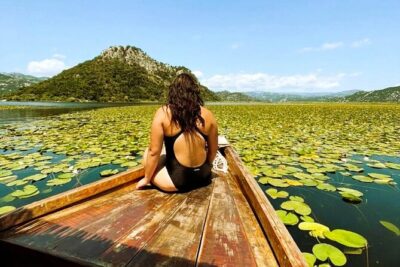
Skadar Lake National Park Guided Boat Tour with Wooden Boat
Read our review →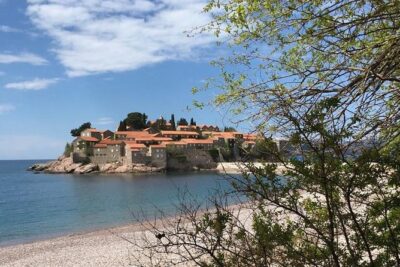
Best from our coast (Kotor bay, Budva, Sv Stefan, Skadar lake)
Read our review →
GREAT MONTENEGRO TOUR Cetinje – Njeguši – Kotor – Budva – Bečići – Saint Stefan
Read our review →
Skadar Lake National Park: Guided Boat Tour to Kom Monastery
Read our review →
Private transfers from Podgorica Airport and city to Budva
Read our review →
Durmitor – Black Lake & Tara River Canyon – North Montenegro tour
Read our review →
Podgorica Historic, Safari and Winery tour – Skadar lake and River Crnojevica
Read our review →
Private Full-Day Tour in Moraca and Tara Canyons, Durmitor & Biogradska Gora NP
Read our review →Browse the lists this tour appears in